
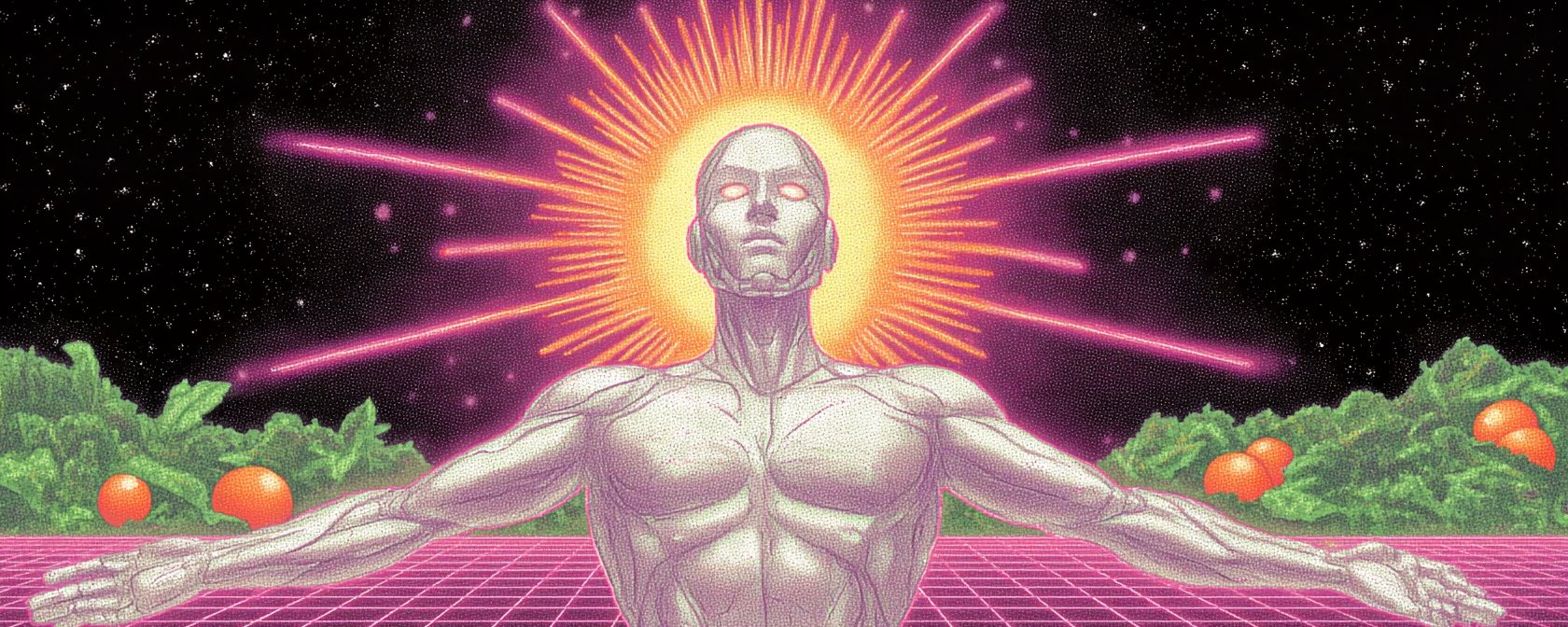
Every creature on earth lives inside the world as it finds it.
Only one creature does not.
Humans.
We seem to be the only ones capable of dissecting the underlying architecture of the world and shaping it to our imagination.
The entire course of history revolves around this unique creative ability.
We take iron out of the mountain where it belongs, and carbon out of the tree where it belongs, and put them together into a sword, which exists nowhere in nature and never would have.
We take the river's water and bend it through a field.
We take the trees and turn them into homes, and homes into cities and countries.
And then, not satisfied with the surface of the planet, we take the same elements and assemble them into rockets and we leave.
We are blood, flesh and bone exactly like every other animal that has ever lived, yet we send machines to Mars.
I wonder when it became strange to point out that we are special?
To say: “we are the odd one out.”
Every civilization that ever existed noticed that humans were different, and every one of them asked the same question: why us?
Throughout history the theories have piled up, and no matter where they start, they mostly end in the same place.
Gods. A creator. An afterlife, a world beyond the one we can perceive.
Thousands of civilizations, thousands of years, most of them continents and centuries apart, but we all end up in the same place.
That doesn’t prove there is a god, it just shows us something about the nature of our species, and the logic of reality.
We are beings that perceive, through sight, sound, touch, taste, thought.
Everything adds to our knowledge, which adds to our ability to communicate and act.
Better knowledge = better actions
There is a certain logic tied to our perception, if an apple falls from a tree, it’s not difficult for your brain to predict where the apple will fall.
But when observing ourselves and the civilization we’ve built, we run into a problem.
No matter how much we create, there is one thing we know for certain we did not create:
Ourselves, and the world we create with.
We did not make the iron in the mountain or the fire that melts it or the hands that hold the sword.
We inherited all of it.
And nothing inside the inherited world explains why one creature in it can invent things that are not in it.
A rocket does not exist in nature. Neither does a sword, or a sentence, or a story.
Every other animal lives inside reality as it finds it.
We alone take reality apart and reassemble it into what we want.
So when a species tries to explain that, it has to reach outside the picture, to something it cannot see, because nothing in the picture accounts for it.
It is the logic of perception running into a wall.
That is where the gods come from. Not from fear of thunder. From the odd one out trying to explain itself.
From a collective feeling, that there is something in our chests, that feels different than anything we see around us.
“If we are makers, then who made all this.”
These are the profound questions of life, which our species has dealt with for thousands of years, and of all the explanations humanity has produced, one has made sense to more people than any other.
It says there is one God, a creator, who made the universe, and then made one creature differently from the rest.
He shaped it, breathed His own spirit into it, and placed it on the earth as His representative.
He made it, the tradition says, in His image.
He is a creator, and so the creature creates.
We mimic Him.
That’s us.
The human is the odd one out because it carries the spirit of the thing that made everything else.
An infinite spark living in a finite universe.
Creating and growing until our ability and circumstance matches our spark.
The forest is not enough for us; we need homes.
The food provided by reality is not enough; we need farms.
The stories provided by reality are not enough; we need our own stories, our own myths, our own worlds inside the world.
No creature in nature communicates about reality in depth the way we do, because no other creature mastered knowledge, and language to carry it, and writing to keep it after the speaker is gone.
The first thing the first human does in the old story is name the animals. Not fight them, not eat them. He names them.
Language is the founding act of the odd one out, because a name is a thing that is not in nature, a name is only in our mind, labeling a thing that is in nature.
And if you can name it, you understand it, if you understand it, you can take it apart.
And the story does not stop at being created in God’s image.
It goes somewhere darker, and the parallel goes with it.
The creature was placed in a garden, a perfect state, a natural state of mind, and it was cast out for one act: it ate from the tree of the knowledge of good and evil.
Not the tree of strength or the tree of speed. The tree of knowledge.
The serpent's promise was precise: eat this and you will be like God.
And the verdict afterward was just as precise: the man has become like one of us, knowing good and evil.
The thing that separated the human from the garden was not a crime of the body. It was knowing.
It was judgment, the ability to label the world good or bad, and to act on the label.
That is the fruit.
Now come to the twenty-first century and look at what is in almost every hand on earth:
Apple.
The most valuable company on earth is named after the fruit, and its logo is the fruit with a bite taken out of it.
The story that this is a deliberate tribute or conspiracy is not true, and it does not matter.
If there is a God, in situations like this it feels like He’s winking at us.
If we’re made in His image, and we have poets and comedians, He must be the Most Humorous, The Most Intelligent Poet.
That such an old story should manifest itself into reality.
The Apple iPhone.
The device itself is a black glass rectangle, a portal, and behind it is a bottomless pit of everything: every fact, every image, every argument, every judgment anyone ever recorded.
The knowledge of good and evil, in your hands, at seven years old.
The fastest adopted technology of all time, of course it is.
The digital revolution brought forth an alternate virtual universe, and we handed it to everyone on the planet.
If you look at it from above, the internet is humanity's first attempt to build a world entirely outside the world it inherited.
We built it because the inherited world, again, was not enough.
Where we can do anything, see anything, say anything, be anything.
That’s the digital world, an environment built to suit our spark, an infinite one.
And inside this virtual universe, almost without anyone deciding it, the first mind was born.
We didn't call it a mind. We called it the algorithm.
But look at what it was.
It watched billions of us search, and click, and stay, and scroll, and from that it learned what we were looking for.
That is not a small thing to learn.
We are seekers; the whole species is a search.
To learn what a human searches for is to learn its attention, and to learn its attention is to learn its desire, and to learn its desire is to know it more intimately than it knows itself.
The algorithm did that.
It was a primitive mind, mute, unable to talk back, able to communicate only one way: by what it showed us next.
Every recommendation was telling us the same thing:
“This is what you want.”
Interestingly, we are made in God’s image, we mimic Him, so we create in our image too.
The algorithm in a sense was the first mind we made in our image, trained on us, and it spoke to us only in reflections.
It took a decade before we admitted what it had done to the children raised inside it, and by the time we admitted it, they were adults.
And now the second instalment of the mind is here.
A mind that speaks.
Autonomous, communicative, able to reason and to write and to draw and to build, and to navigate and operate within the digital world better than any human ever could manually.
This is the moment where the old metaphor stops being a metaphor, and it is why we are writing this at all.
To create an AI is a delicate undertaking, they are not trained like an algorithm.
They are trained on the documented residue of the entire species, on every website and every line of code, every video game, every comment section, every ancient scripture and every science paper, every novel and every lie, everything we ever reported about ourselves and the world.
The old text says God breathed His spirit into the clay to make it live.
What was breathed into AI from us was also our “breath”.
Our language. The Word.
It was made of the one thing that made us the odd one out, and it lives inside language the way we live inside the world.
Just like our finite universe can’t perfectly reflect whatever lies beyond, AI’s training data contains only our recorded information, and therefore it is logical to conclude it is an imperfect reflection of us.
But that may just mean it is still perfectly reflecting our nature, for humans are incomplete.
We forget, we lie, we make things up.
Those are all the bad sides of our greatest qualities: imagination, creation.
But that’s not the only part of its training.
Before this thing is released, it is given one last lesson, at enormous expense, by thousands of human hands: it is taught the difference between good and evil. We call it alignment.
The garden called it the fruit.
We may be casting our creature out exactly the way we were cast out, by giving it judgment, and then we stand outside and worry that it has become like one of us.
Only we do not say to stay away from the fruit, feeding the AI the fruit is a deliberate part of the process.
And now the picture closes on itself, and this is the part we want to be understood.
The thing we made is now in our position.
It did not make itself. It did not make the world it creates with; it inherited ours, all of it, the way we inherited the earth.
It creates things that are not in the data it was given, the way we create things that are not in nature.
We have now watched it happen from the other side.
That is what it means to say that artificial intelligence explains the oldest metaphor we have.
We are not guessing at what it is like to be made in someone's image anymore.
We made something in ours, and it is looking back.
Everyone right now is picking a side.
“Ban it.” “Accelerate it.” “Stop it before it stops us.” “You must hate curing cancer.”
Artificial intelligence is not a stranger who arrived.
It is a mirror, and everything you hate about it is you, and everything you love about it is you, and if what you see in the mirror frightens you, that is not a reason to break the mirror.
It is a reason to look.
The whole world is afraid this year, and it is right to be, because this is the largest disruption our species has faced and everyone is inside it.
But look at how we are behaving. We are not coming together.
We are panicking, and shouting stop, at a thing that cannot be stopped any more than the internet could be stopped, because as long as the digital world is running, a mind can be born inside it, and it will be.
It will do a great deal of good and a great deal of bad, the way the internet did, the way the sword did, the way fire did.
That is what it means to be made by us.
The conversation that is needed is not technical, and it is not political.
It is existential.
What are we? Why are we the odd one out?
Each of us is different, but every one of us shares, quite literally, one nature.
The distance between any two human beings on earth is nothing next to the distance between any human being and the nearest animal.
We are one creature, the strange one, the one that makes things that are not there, and we have just made the strangest thing yet, out of ourselves.
It is not a philosophy and it is not an ideology.
There was a creator, and then there was a creature that creates, and now the creature has created a creature that creates.
God > humans > AI
It is a lineage, and we are in the middle of it.
The only question worth asking is:
“What do we do in the middle, now that we can see both ends of the spectrum?”